Frequently Asked Questions (FAQ)
about Oradour-sur-Glane 10th June 1944
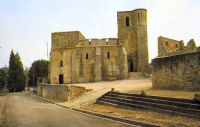
Catholic church of Oradour-sur-Glane
1) Why was this website created?
The simple answer is that I read the Robin Mackness book, "Oradour Massacre and Aftermath" and became intrigued by the story. One thing led to another and from being the subject of a few hours idle amusement, this website grew into existence: see also FAQ 22 below.
2) Does the narrative, In a Ruined State, appear in printed book form?
I decided from the start not to try and publish my findings in book form, as it was my intention to expose the story to the dynamic criticism of the World Wide Web and thus to take advantage of all comments in order to reveal any weaknesses in my story. To date I have had a whole series of very useful and valid observations regarding the accuracy of this website as to points of detail and my thanks go to all of you who have taken the trouble to write.
3) Why do you show links to Revisionist sites, for example to the AAARGH site?
I have now removed the Links page as Google does a far better job, if you want to see the AAARGH (or any other) website, do a search using your favourite Search Engine.
4) How did the confusion over the spelling of Diekmann's name arise?
I have seen his name spelt as, Diekmann, Dickmann and Dieckmann, all of which are common surnames, as can be seen by looking at a current German telephone directory. However the correct spelling from his SS records was, Diekmann and his first name was, Adolf, not, Otto, as appears in many publications. The original confusion, in my opinion, came about at the time of the trial in Bordeaux in 1953. The trial was widely reported in the world's press, most of whose reporters did not speak German. The name Diekmann to an unfamiliar ear sounds like Dickmann, which to English speakers is a more natural spelling. From the newspaper reports that I have read this is when the confusion first began and subsequent authors have perpetuated the error. As an example of this, Max Hastings in his book, "Das Reich, the march of the 2nd SS-Panzer Division through France" published in 1982 quotes the name as Otto Dickmann and Sarah Farmer in her book, "Oradour Martyred Village" published in 1999, took her spelling from Hastings book (she confirmed this to me by e-mail). The confusion with his first name is I think simply due to reporters at the trial in 1953 confusing "Otto Kahn" (Diekmann's second in command) with Diekmann. The trial was known in France at the time as, "L'affaire Kahn et Autres", due to Kahn who was known to be still alive at the time, (but thought to be hiding in Sweden) being the senior of those who were tried in their absence.
Strangely, Robert Hébras in his book, "The slaughter of our village", published after 1999 (see Bibliography), consistently throughout the book, quotes the name as being Dickmann and even shows a photograph of the grave headstone on page 166 (of the English translation) and specifically states that: "The name of Dickmann is spelt Diekmann". Why Hébras persists in this mistake is unknown to me, especially as in 2003, I gave the Centre de la Mémoire a copy of all Diekmann's SS records (at that time they did not have any original, German language SS personnel data at all).
5) French names: how do you pronounce?
a) 'Oradour-sur-Glane'?
Oradoor-sur-Glarn
b) 'Tulle'?
Like the Tul part of, Tulip.
c) 'Charly' (as in Charly-Oradour)?
Sharly
6) German names: how do you pronounce? (the stress is on the first syllable in each case):
a) 'Diekmann' ?
Deek-man
b) 'Kämpfe' ?
Kemp-fuh
c) 'Kahn' ?
Kaan
d) 'Stadler' ?
Sh-tad-ler
e) 'Weidinger' ?
Vi-ding-er
f) 'Lammerding' ?
Lah-mur-ding
g) 'Barth' ?
Bart
7) Where is Oradour, how do I get there and where can I stay?
See: How to get there and places to stay and the Village Plan in the Appendices section of this site.
See also: The Oradours of France, so as to make sure you go to the right Oradour.
8) How much does it cost to see the ruins of the village?
Nothing at all, but see the 'Centre de la Mémoire' section of, How to get there and places to stay
9) When is the Centre de la Mémoire open?
See: The 'Centre de la Mémoire' section of, How to get there and places to stay
10) Can I take my dog into the ruins and or the Centre de la Mémoire?
The short answer is "No", but there is an exception for guide dogs of all types, however normal dogs are specifically excluded. This exclusion is mentioned on the information boards outside the Centre de la Mémoire and is unambiguous.
11) Can I buy explanatory material and / or refreshments at the Centre de la Mémoire?
There is a wide range of books and leaflets available in the Centre. The most common language supported is French with English and German editions available for many publications. There is also a video tape in PAL, SECAM and NTSC formats and a DVD (see Bibliography). There are no refreshment services in the Centre, but it is less than a 5-minute walk into the new Oradour with its restaurants and hotels.
12) Why does the Centre de la Mémoire not reply to me when I write with a query?
I do not know, but this seems quite normal, or at least for there to be a very delayed reply. As a suggestion, write in French and include an International Reply Coupon to maximise your chances. They do seem to have a somewhat dismissive attitude towards anyone who seems to question, even slightly, their version of events and anyone expressing any sympathy or support for the SS is unlikely to get much help.
As an alternative, you can try contacting them via the link on the official website Home Page. This gives an enquiry form which asks for your name and email address and is currently available in French.
13) What spelling and date conventions are shown on this website?
All spelling is to the British (United Kingdom) standard. The calendar system used in Germany and France for writing the date is the same as is used in the UK and follows the Day-Month-Year format. All the dates quoted on this website follow this convention. For example, 10-6-44 means the 10th of June 1944 not October 6th 1944.
14) What currency is used in France at the present time?
For those of you wishing to visit France and see for yourselves the locations mentioned in this website, it should be noted that starting on 1st January 2002, France changed its currency from the French Franc (FF) to the euro (€). This process was completed on 17 February 2002 and after that date only euro were legal tender. The exchange rate for the Franc to the euro was fixed at, €1 equals FF 6.55957.
See: How to get there and places to stay for exchange rate details for the € and the $
In English the plural of euro, is euro and it was originally intended to be written entirely in lower case.
15) What is my personal opinion of the SS?
See the section in the Appendices headed, The SS a personal view
16) Who pays for this website?
I do, entirely without any funding, sponsorship or advertising from any source whatsoever. I have on occasion allowed third parties to use my copyrighted material from this website for their own purposes either at no charge or sometimes upon payment. I have never exercised any editorial control over the use of this material and am not in any way responsible for the manner of its use.
17) Am I connected in any way with the Centre de la Mémoire, or any other organisation associated with either Oradour-sur-Glane, the French resistance or the SS?
I am entirely independent and the views expressed throughout this website are mine alone.
18) Will I accept mutual linking to other websites?
Not necessarily: the initiative for linking has to come from me. In order to show that this is an independent and impartial website with a serious message I must be very selective in to whom I show a link. In the past, approaches have been made by what have turned out to be either biased and / or ephemeral websites and linking to such places would not engender confidence in this website.
19) Why is "website" now spelled as such throughout these pages?
This decision follows from the publication in the UK of the latest edition of the Collins dictionary. I do appreciate that there are some differences of opinion on this subject, but for consistency it is going to be spelled as described above and not shown as either, web site, Web Site, web-site, Web-Site, or Website (unless it starts a sentence).
20) Why is Oradour-sur-Glane referred to as being a village and not a town on this website?
There are considerable differences between countries as to how they define a City, Town, Village and Hamlet. The definitions used on this website are as follows, City: a centre of habitation containing a Cathedral, a bishop's See and usually, but not always having a large population. Town: a centre of habitation containing more than one church and having a regular market. Village: a centre of population containing a church and a regular market. Hamlet: a small centre of population with neither church nor market and often without any shops or bakery. Obviously different definitions have applied in the past, for example in pre-Christian times a city (such as Rome) would not have had a Cathedral.
It is common to see confusion in the literature about Oradour as to whether it is a town or a village. For example in "Oradour the final verdict - The anatomy and aftermath of a massacre", by Douglas W. Hawes; on page 121: "Pfeuffer said that he had been part of a group which had gone to the north end of town to round up outlying farmers and to ensure that no one entered or left the village".
It is quite normal for even very small villages in France to have a "Hotel de Ville", (in English translation, a "Town Hall"). This designation is applied to any centre of local government, no matter how big or small, for example even Paris has a "Hotel de Ville" (an alternative name for such a building is "Mairie" and usually, but not always, this is used for the smaller locations).
As an illustration of today's terminology, see the photograph of a van parked by the Oradour-sur-Glane cemetery in June 2010. This vehicle has been sign-written with: "Ville d'Oradour s/ Glane" and shows that today, Oradour is a Town (at least in the eyes of the sign-writer).
21) How are the French and German accented characters on this website typed using an English language keyboard?
See: Accents and commonly misspelled words on this website.
22) How accurate is the Robin Mackness book, Oradour Massacre and Aftermath? (Robin Mackness died on 11th January 2021).
This book is in two main intertwined parts with a third, shorter tail-piece. The first part deals with Robin Mackness's experiences at the hands of the French customs and I have absolutely no query or criticism whatever about this section.
The second part, explains the massacre at Oradour in terms of the SS, under the command of "Otto Dickmann" going to the village, in order to recover about a half-ton of gold taken from them by a man Mr. Mackness called Raoul. This explanation was given to Mr. Mackness by Raoul himself and to put it quite simply, I do not believe it. I am not accusing, or even suggesting that Mr. Mackness is lying. I can believe that he has recounted accurately the explanation that Raoul gave him, but I do not believe Raoul's story. Read Chapter 7 of In a Ruined State if you need further detail.
The third part of the book, has Mr. Mackness travelling round France visiting various locations and meeting several people mentioned in the text. Two of these incidents are, firstly, visiting Helmut Kämpfe's grave and secondly, interviewing Captain (Hauptsturmführer) Kahn. No exact dates or locations are given for either of these events, but as both followed Mackness's release from French custody in September 1984, they have to be after this date. In the book Kämpfe's grave was quoted as being "about 50 kilometres from Oradour" and marked simply: "Soldat Allemagne"(German Soldier), but see his grave's headstone on this website. The meeting with Kahn is quoted as taking place whilst he was travelling from Sweden to Switzerland in 1985 for medical treatment, but see his grave's headstone on this website.
23) What is the music played in the TV series, The World at War?
The World at War was a programme released in the UK by Thames Television in 1974. It takes the form of a 26-part documentary on the history of World War II, each episode lasting for 52 minutes. It was produced by Jeremy Isaacs with narration by Laurence Olivier and original music by Carl Davis. The opening sequence of the 1st episode and the closing of the 26th, feature Oradour-sur-Glane with a narration spoken by Laurence Olivier (the choral music played at the end of the last episode as the camera pans over Oradour, is the Kyrie, from the St Nicholas Mass by Haydn): see the Bibliography for further details of The World at War.
© Michael Williams ... revised: 22 November 2024.